Thursday, May 17, 2012

Does the Law of the Sea Treaty have a Chance of Passing the US Senate?

Next week, Secretary of State Clinton and Secretary of Defense Panetta will brief the Senate on the United Nations Convention on the Law of the Sea, otherwise known as UNCLOS. The treaty has been around for decades, and was originally signed by President Reagan, but never ratified by the Senate.
The treaty provides rules of the road for the high seas, maritime rights and seabeds.  The military supports the treaty because it offers clarity on sea-lanes; the extractive industry supports it because it provides a mechanism to make legal claims to minerals below seabeds; environmental groups like it because it provides guidelines to extracting those minerals in an ecologially sensitive way; peace groups support it because it is one part of the liberal internationalist project. Even George W. Bush, who no one would confuse as a liberal internationalist, even supported it.
Outside a few blocks of Washington, DC UNCLOS is totally uncontroversial. But inside the US Capitol building, the treaty has languished. Ratifying a treaty requires a two thirds vote of the US Senate, so if everyone is present that requires 67 votes in favor.
There is a not-insignificant minority of US Senators who have ideological hangups with the very idea of international law and treaties.  Under no circumstance would they vote for a treaty or something that can be construed as international law.
The size of this minority will determine whether or not the treaty can be ratified.
So how many senators are probably intrinsically opposed to UNCLOS? Treaty votes are somewhat rare, so it is hard to get a handle on where Senators stand on treaties in general–and UNCLOS in particular. However, in 2009 there was one vote that could offer some insights into Senators’ ideological predilections on questions on international law.
Shortly after becoming Secretary of State, Hilary Clinton nominated Harold Koh to serve as her legal advisor. This is a top position which requires senate confirmation and he was filibustered.  No one questioned Koh’s abilities: he is an internationally renowned legal scholar, former Dean of Yale Law School, and held top positions in the State Department during the Clinton administration. Still, some Republicans blocked his nomination over Koh’s record of support for the idea that foreign and international law can help inform American jurisprudence. In other words, they tried to block his nomination because he believed in the validity and applicability of international law.
Here was the vote breakdown on his nomination, which was filibustered so 60 votes were required to pass. I’ve crossed out the names of Senators who have been replaced since this 2009 vote by someone who might vote differently.

YEAs —62
Akaka (D-HI)
Baucus (D-MT)
Bayh (D-IN)
Begich (D-AK)
Bennet (D-CO)
Bingaman (D-NM)
Boxer (D-CA)
Brown (D-OH)
Burris (D-IL)
Cantwell (D-WA)
Cardin (D-MD)
Carper (D-DE)
Casey (D-PA)
Collins (R-ME)
Conrad (D-ND)
Dodd (D-CT)
Dorgan (D-ND)
Durbin (D-IL)

Feingold (D-WI)
Feinstein (D-CA)
Gillibrand (D-NY)
Hagan (D-NC)
Harkin (D-IA)
Inouye (D-HI)
Johnson (D-SD)
Kaufman (D-DE)
Kerry (D-MA)
Klobuchar (D-MN)
Kohl (D-WI)
Landrieu (D-LA)
Lautenberg (D-NJ)
Leahy (D-VT)
Levin (D-MI)
Lieberman (ID-CT)

Lincoln (D-AR)
Lugar (R-IN)
Martinez (R-FL)
McCaskill (D-MO)
Menendez (D-NJ)
Merkley (D-OR)
Mikulski (D-MD)
Murray (D-WA)
Nelson (D-FL)
Nelson (D-NE)
Pryor (D-AR)
Reed (D-RI)
Reid (D-NV)
Rockefeller (D-WV)
Sanders (I-VT)
Schumer (D-NY)
Shaheen (D-NH)
Snowe (R-ME)

Specter (D-PA)
Stabenow (D-MI)
Tester (D-MT)
Udall (D-CO)
Udall (D-NM)

Voinovich (R-OH)
Warner (D-VA)
Webb (D-VA)
Whitehouse (D-RI)
Wyden (D-OR)

NAYs —35
Alexander (R-TN)
Barrasso (R-WY)
Bennett (R-UT)
Bond (R-MO)
Brownback (R-KS)
Bunning (R-KY)
Burr (R-NC)
Chambliss (R-GA)
Coburn (R-OK)
Cochran (R-MS)
Corker (R-TN)
Cornyn (R-TX)
Crapo (R-ID)
DeMint (R-SC)
Ensign (R-NV)
Enzi (R-WY)
Graham (R-SC)
Grassley (R-IA)
Gregg (R-NH)
Hatch (R-UT)
Hutchison (R-TX)
Inhofe (R-OK)
Isakson (R-GA)
Johanns (R-NE)
Kyl (R-AZ)
McCain (R-AZ)
McConnell (R-KY)
Murkowski (R-AK)
Risch (R-ID)
Roberts (R-KS)
Sessions (R-AL)
Shelby (R-AL)
Thune (R-SD)
Vitter (R-LA)
Wicker (R-MS)

New members of congress include: Senator Brown from Massachussetts who is a toss-up. Senator Voinovich, a GOP “yes” vote, was replaced by Senator Rob Portman a Republican who is probably a toss-up. Senator Spector was replaced by Senator Pat Toomey, who is almost certainly a “no” vote.  Senator Feingold, a “yes” vote, was replaced by Ron Johnson, a probable “no” vote.  Senator Lincoln, a yes vote, was replaced by Senator John Boozman, a likely “no” vote. Judd Gregg, a “no” vote was replaced by Kelly Ayotte, a probable “no” vote, so that’s a wash. And Sen. Dodd was replaced by Sen. Blumenthal, also a wash.
So, my back-of-the-envelope calculations suggest that the “yes” votes are down to 59, meaning the pro-treaty side needs to somehow find 8 more votes from the “nays” or toss ups.  In a tense election season in which less than moderate republicans (like Dick Lugar) are being toppled by their Tea Party opposition, I would imagine that treaty ratification will be heavy lift. On the other hand, the fact that the White House and Senate Democrats are making a push for UNCLOS ratification suggests that maybe they think they have a few votes in the bag.
In any case, this is a very important vote for those of us who follow UN issues.  UNCLOS is the lowest of low-hanging fruit.  If a totally uncontroversial treaty like Law of the Sea can’t pass the Senate,  there’s little chance that other treaties in the pipeline (like the Convention on the Rights of the Child or Convention on the Elimination of all Forms Discrimination Against Women) will ever be passed.


Friday, May 11, 2012

Combating Piracy and Oil Theft in Nigeria
11 May 2012

'MARPAC's "In Focus" (Maritime Forces Pacific Royal Canadian Navy)

Royal Roads University, the Asia Pacific Center for Security Studies, and Maritime Forces Pacific will be holding the biennial Maritime Security Challenges conference in Victoria BC from October 1-3, 2012. One of the conference panel discussions will focus on security issues in the Gulf of Guinea.  This article explores key maritime concerns in this region and discusses some of the political and economic factors that make improving security in the Gulf of Guinea such a challenge. More information on MSC2012 can be accessed at: www.mscconference.com

 Much has been written about Somali piracy and its threat to the international shipping industry. However, there is also a growing piracy problem on the other side of the African continent, in the Gulf of Guinea. According to the International Maritime Organization, 2011 marked a peak year for pirate activity in the region, with 64 reported attacks, a 28 percent increase from 2010. The waters off Nigeria are particularly risky: Africa’s most populous country and top oil producer is home to a strong network of criminal organizations that have increasingly targeted ships carrying valuable cargo. In coming years, shipping traffic off the coast of Nigeria is projected to increase, as world demand for its oil grows. The risk of hijacking, however, could discourage international shipping vessels from approaching Nigeria’s ports.
 
 Improving security in Nigerian waters will not be easy. It will require coordinated action among naval and coast guard fleets to fend off pirate attacks. It will also require taking action against land-based criminal groups, and the government corruption that allows them to thrive. In addition, a long term strategy against piracy and organized crime must include measures to address the extreme poverty and inequality that have driven Nigerians to pursue illicit activities. Piracy is a symptom of deeper economic, political and environmental problems, all of which need to be examined and rectified in order to put a permanent end to piracy and oil theft.
 
Theft at Sea
 
 The International Maritime Bureau has recorded 10 attempted hijackings off Nigeria in the first quarter of 2012, though the real number is likely much higher. The majority of the attacks occurred near the Niger Delta and targeted ships carrying oil. Unlike Somali pirate attacks, which have focused primarily on hostage-taking for ransom, Nigerian attacks have focused on stealing cargo. The pirates are usually equipped with automatic weapons, communication devices, and improvised oil tankers to transport their plunder. They have been known to attack ships over 70 nautical miles from shore.
 
 Although piracy has occurred in Nigerian waters since the late 1970s, the problem has received relatively little government attention and has flourished unchecked. There have been many reports of crews broadcasting distress calls, but receiving no response from the Nigerian authorities. Furthermore, there have been many allegations that government officials have turned a blind eye to the issue, or have actively colluded with criminal groups to receive a share of piracy profits.
 
 In the past decade Nigeria has increased its naval and coast guard capabilities. Nigeria opened a regional Maritime Rescue Coordination Centre (MRCC) in Lagos in 2008, and signed a multilateral agreement with neighbouring countries on streamlining search and rescue operations. This February, the Nigerian Navy hosted naval forces from 11 other nations in a four-day exercise focused on crime prevention at sea. The Navy has also budgeted funds to purchase more than two dozen new patrol vessels this year. Despite recent improvements, however, the country’s maritime forces are still under-equipped for the considerable task of patrolling Nigeria’s 853 kilometre coastline.
 
Fighting Piracy on Land
 
 While it is important to increase the capacity of the coast guard and navy to prevent pirate attacks, piracy at sea stems from the deeply engrained land-based problem of organized crime. Nigeria’s coastline is notorious for its criminal networks, armed insurgents, and thriving black market, especially in the oil-rich Niger Delta region. Criminal groups have established hidden camps among the mangrove forests of the Delta, taking advantage of the labyrinth of swamps and creeks. From these camps, they launch waterborne attacks against ships then retreat to the complex waterways of the Delta.
 
 Many of the camps belonging to criminal groups house illegal refineries, used to process oil that has been stolen from ships or from pipelines. An estimated 100,000 barrels of oil per day are illegally diverted from the pipelines that criss-cross the Delta, in a process referred to as “illegal bunkering.” Approximately 10 percent of Nigeria’s refined oil supply comes from illegal bunkering and refining operations. There is a well-established black market, which is reported to involve officials at all levels of government, selling oil to customers across Nigeria and in neighbouring countries.
 
 The various groups in the Niger Delta have different motives for stealing oil. Insurgent groups such as the Movement for the Emancipation of the Niger Delta (MEND) have turned to oil theft – as well as kidnapping – for political reasons, mainly to raise funds for their armed struggle for control of local resources. They are opposed to the state’s alliance with oil companies, and claim that oil theft is a just form of vigilante wealth redistribution. Other criminal groups have the more immediate motive of personal enrichment.
 
 Cracking down on oil theft and organized crime with military force has proven complicated. During the 1990s and the early 2000s, the region became increasingly militarized; as state security forces increased their presence to protect oil fields and pipelines, criminal operations and militias acquired huge stocks of modern weaponry. The military launched counter-insurgency campaigns, and the ensuing clashes with armed criminal and rebel groups resulted in many casualties and a significant displacement of civilians. Violence eased following an amnesty in 2009, but there are still regular reports of clashes and bomb attacks launched by militia groups. The conflict has hindered oil production, with output dropping 20 percent between 2006 and 2011.
 
 Currently, the military is again trying to ramp up its operations in the Niger Delta. In early 2012, the Air Force opened a new Mobility Command Headquarters in the Delta, and the Navy is also looking to establish a permanent presence to facilitate raids on criminal hideouts. A joint military task force, codenamed Operation Pulo Shield, was launched in January 2012 to combat oil theft, and has raided close to 100 bunkering and refining operations. The authorities are making a serious attempt to strengthen the rule of law, although some fear that the increasing military presence in the region will anger local communities and renew the cycle of arms accumulation and violence.
 
Addressing Root Causes
 
 The government’s strategy against piracy and organized crime has received criticism from some community leaders and analysts for failing to address the key economic and political issues that engender conflict and criminality in the first place. Indeed, a long term strategy against piracy and oil theft in Nigeria must somehow address the severe poverty of the Niger Delta region, as well as the endemic corruption and mismanagement in the Nigerian oil sector that see revenues go only to the top echelons of society.
 
 The foreign oil companies that began drilling in the Niger Delta in the 1960s have made billions of dollars in profits. The Nigerian government has also benefitted immensely, with oil profits representing 80 percent of federal revenues. The country’s political and business elite have received a hefty share, as have the ruling elite in the Niger Delta. Oil revenues that could have been invested in social programs, infrastructure and economic opportunities in the Delta have largely been diverted to projects in other regions, inflated government and industry salaries, or simply pocketed by corrupt officials.
 
 The people of the Niger Delta perceive this as a grave injustice. The local people who are most affected by the industry have watched in frustration as rich foreign oil workers come to stay in luxurious enclosed camps, while most of the nearby villages lack basic services. Over 70 percent of the Delta’s 30 million people have no access to electricity, clean water, or medical care. Despite government and industry claims that oil would bring development to the country, the average Nigerian in the Delta region is probably worse off now than before oil was discovered.
 
 Some reports suggest that in the Niger Delta, piracy and illegal oil operations are among the only economically rewarding occupations available in a region where the adult unemployment rate is around 70 percent. Traditionally, Niger Delta communities survived on fishing and agriculture, but 50 years of irresponsible oil industry practices have poisoned the water and soil, turning the Niger Delta into one of the most contaminated zones on earth. Crop yields have declined, and fish stocks have collapsed almost completely. Foreign oil companies are not entirely to blame, as illegal bunkering and refining operations have also been very damaging.
 
 The UN Environment Programme estimates that it would take up to 30 years of intensive clean-up efforts to restore the region. In 2011 the Nigerian government was discussing a billion-dollar cleanup plan, but progress has stalled, and there are rumours that the project may be cancelled altogether. Yet restoring the environment and nurturing economic alternatives are key steps to improving security for the local population, the oil industry, and the shipping industry.
 
Conclusion
 
 Nigeria is facing a grave problem with crime on land and at sea, and the country has begun to address the issue by strengthening its maritime security forces and cracking down on organized crime in the Niger Delta region. The government is financially dependent on oil revenues, and is aware that it needs to improve security in order to maintain oil production and export levels. However, improving long term security for tankers and oil rigs cannot be accomplished with military force alone. There is a need for a two-pronged strategy, which both deters criminal activity by increasing military patrols, and addresses the underlying problems of poverty and corrupt governance that make criminality so appealing.

Tuesday, May 8, 2012

Cuts force Royal Navy to drop Somalia piracy patrol

Four frigates scrapped in defence review leave navy unable to commit full-time to David Cameron's foreign policy priority


(..this may be why the cutbacks are in place but these are no anti-piracy vessels..they plan for yesterday's wars, while piracy is here and now....what was that saying about governments always planning for the last war?.....)
The UK has had to scale back its commitment to counter-piracy because the Royal Navy no longer has enough warships to dedicate one to Somalia all year round.
While the US, France, Italy, Denmark and other nations still send frigates to thwart criminals who cause havoc with international trade, the Guardian has learned that Britain has quietly withdrawn its ships from these patrols, even though David Cameron has made Somalia's piracy problem a foreign policy priority.
Piracy cost the world economy $7bn (£4.3bn) last year. Figures show the pirates raised almost $160m from hostage ransoms, but 24 of their captives died.
British businessman David Tebbutt was one of their victims, and his wife, Judith, was held for six months before being released in March.
Because of defence cuts, the UK can deploy only two frigates for contingency operations east of the Suez canal. They have to cover a massive area of ocean stretching from the Gulf to the Falklands. Neither can be committed to piracy full-time, though HMS Westminster "dips in" when it can, sources say......(click here for full story)

Friday, May 4, 2012

My leaky barge of the month...

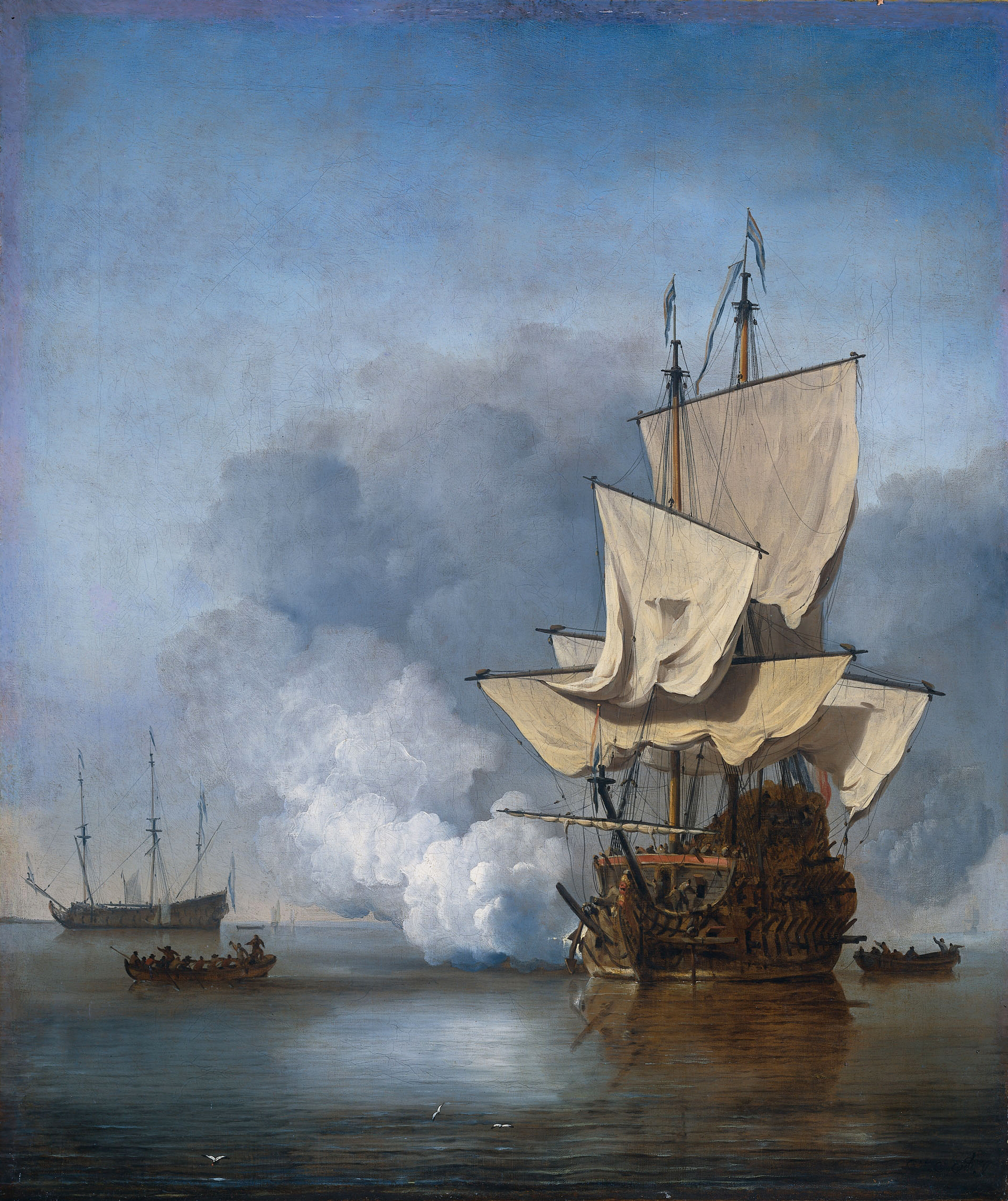
"Het Kanonshcot" by Willem van der Velde the younger (c. 1670)
- click on the painting for the full size image -

Stirring up the South China Sea... a new Asia Report from the International Crisis Group (ICG), dated 23 April 2012


Executive Summary (below)   - (for the full PDF file click here...)

Executive Summary of IGC Report (for full Report click here)

"The conflicting mandates and lack of coordination among Chinese government agencies, many of which strive to increase their power and budget, have stoked tensions in the South China Sea. Repeated proposals to establish a more centralised mechanism have foundered while the only agency with a coordinating mandate, the foreign ministry, does not have the authority or resources to manage other actors. The Chinese navy’s use of maritime tensions to justify its modernisation, and nationalist sentiment around territorial claims, further compound the problem. But more immediate conflict risks lie in the growing number of law enforcement and paramilitary vessels playing an increasing role in disputed territories without a clear legal framework. They have been involved in most of the recent incidents, including the prolonged standoff between China and the Philippines in April 2012 in Scarborough Reef. Any future solution to the South China Sea disputes will require a consistent policy from China executed uniformly throughout the different levels of government along with the authority to enforce it.
China’s maritime policy circles use the term “Nine dragons stirring up the sea” to describe the lack of coordination among the various government agencies involved in the South China Sea. Most of them have traditionally been domestic policy actors with little experience in foreign affairs. While some agencies act aggressively to compete with one another for greater portions of the budget pie, others (primarily local governments) attempt to expand their economic activities in disputed areas due to their single-minded focus on economic growth. Yet despite the domestic nature of their motivations, the implications of their activities are increasingly international. Other factors – both internal and external to China – have also been responsible for increasing tensions, but they are beyond the scope of this study. Regional dynamics, including arms build-ups, competition for resources and increasing nationalist sentiment in other claimant countries are the subject of a separate report.
Effective coordination of actors is also hampered by a lack of clarity over precisely what is supposed to be defended. China has yet to publicly clarify the legal status of the so-called nine-dashed line that appears on most Chinese maps, encompassing most of the South China Sea. While the foreign ministry has taken steps to try to reassure its neighbours that Beijing does not claim the entire South China Sea and has at least partially justified its claims on the basis of the United Nations Convention on the Law of the Sea (UNCLOS), the government cannot easily back down from claims to significant portions of the sea that are based on historical presence in the region. Local government agencies take advantage of this lack of legal clarity when engaging in activities in disputed areas.
Beijing has deliberately imbued the South China Sea disputes with nationalist sentiment by perpetually highlighting China’s historical claims. This policy has led to a growing domestic demand for assertive action. While Beijing has been able to rein in nationalist sentiment over the South China Sea when it adopts a specific policy, this heated environment still limits its policy options and its ability to manage the issue.
In mid-2011, as tensions in the sea led to neighbouring countries seeking closer military ties with the U.S., China adopted a less assertive approach. While Beijing’s overall emphasis on maintaining the status quo still includes a preference for bilateral negotiations, it is strengthening regional relations through high-level visits and multilateral engagement by signing with the Association of South East Asian Nations (ASEAN) the Guidelines for the Implementation of the Declaration of Conduct (DOC) in the South China Sea.
Internally, China has taken measures to calm nationalist sentiment and discourage aggressive actions by local agencies. However, China’s current approach remains characterised by numerous ministerial-level actors and law enforcement agencies with no effective coordinating authority and no high-level long-term policy. While repeated and failed attempts to establish a centralised mechanism on maritime management show a lack of political will to address the coordination issue, Beijing might also see benefit in ambiguity. As long as this situation exists, however, its new conciliatory approach is unlikely to be sustainable. Ultimately, the ability to manage relations in the South China Sea and resolve disputes will present a major test of China’s peaceful rise."
International Crisis Group Report: Beijing/Brussels, 23 April 2012

Friday, March 9, 2012

United States and Law of the Sea


There is a movement underway to get the United States to ratify the Third United Nations Law of the Sea Convention 1982. Some in the United States call it the Law of the Sea "Treaty", so as to give it the acronym LOST. However, the United States is already adhering to the Convention's guidelines, despite keeping its option to take action only in its own interests. While the United States upholds rule of law as its guiding principle, it needs also to lead the way in providing law and order at sea. If it does choose to adopt the Convention though its own domestic laws, it should be able to keep to its principles of acting only in its national interests. International law is not law in the sense that municipal law is, and can be changed to suit changing needs of the state. James Kraska's book (click on the book fo info) is recommended reading but the links in this blog and many other articles will give interested readers a sense of the problem facing those who support the United States signing into law the Convention's guiding principles.Defense Secretary Leon E. Panetta delivered the keynote address at the Law of the Sea Convention forum in Washington, D.C., May 9, 2012.
Panetta spoke at the Law of the Sea Convention forum. Ratifying the treaty, he said, would allow the United States to exert a leadership role in the development and interpretation of the rules that determine legal certainty on the world’s oceans.

To visit the United Nations Law of the Sea Convention, click here....

Click Here for more information on the UN Law of the Sea Convention...